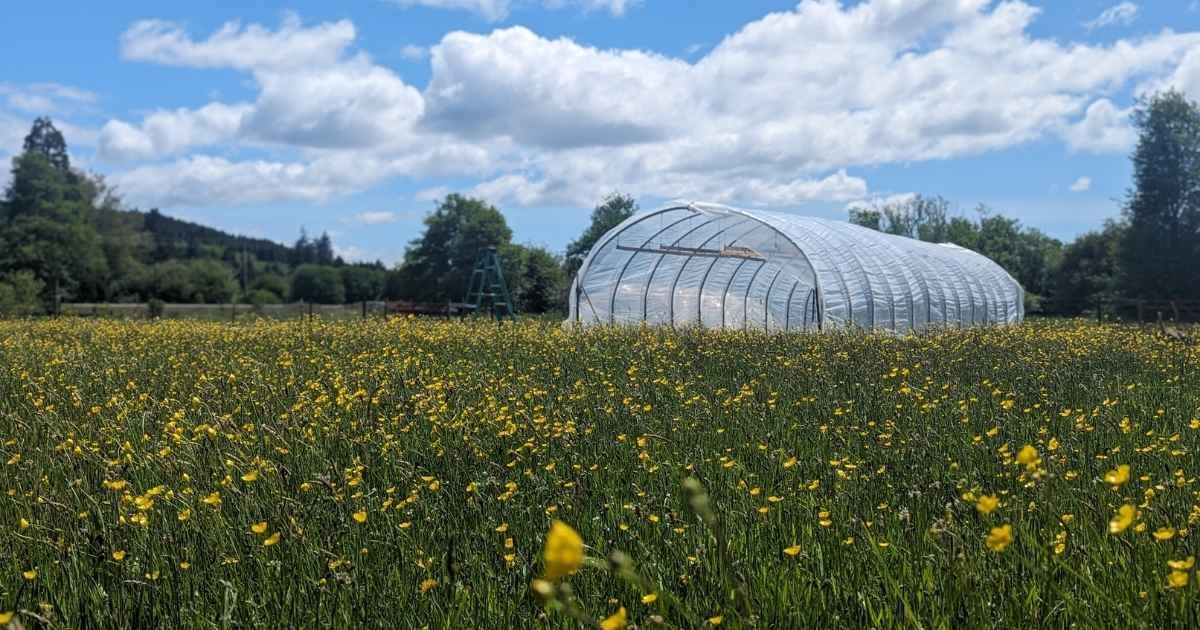
Why We’re Building a Hoop House— and How the EQIP Program Made It Possible
Before we ever started digging holes or bolting steel together, we spent a long time thinking about whether a hoop house (also known as a high tunnel) actually made sense for our farm.
A hoop house is a big investment — not just in money, but in time, labor, and ongoing management. It’s another system to learn, another structure to maintain, and another thing that can go wrong. So this wasn’t a decision we rushed into.
If a high tunnel is something you’ve been thinking about, this post shares our perspective on whether it made sense for our farm, along with some of the options that helped make the project achievable financially.
Why We Wanted a Hoop House
On a small farm, consistency matters.
The weather is unpredictable, especially here. Heavy rain, cold nights, intense wind, and shoulder seasons that never quite behave the way you want them to all make planning difficult. A hoop house doesn’t eliminate those challenges, but it does give you more control over planting, especially early and late season.
For us, the biggest reasons were:
- extending the growing season on both ends
- protecting crops from excessive rain and wind
- improving stem quality and reliability
- smoothing out labor instead of having everything hit at once
A hoop house doesn’t make farming easier — but it can make it more predictable. And predictability is what allows a small farm to plan, plant, and sell with more confidence.
The Pros (From Our Perspective)
Here are the benefits that stood out to us the most:
- Earlier planting and later harvests.
Being able to start earlier and finish later helps spread income and workload across more months. - Crop protection.
Less damage from heavy rain, wind, and temperature swings means fewer losses and better-quality flowers. - More consistent results.
When conditions are more controlled, yields and timing are easier to plan around. - Better use of labor.
Instead of everything happening all at once, work can be spread out more evenly through the season.
The Cons (Because There Are Always Cons)
A hoop house also comes with real tradeoffs, especially on a small farm.
- Upfront cost.
Even a basic structure is a significant investment. - Time to build.
This isn’t a weekend project, especially if you’re doing it yourselves. - Maintenance.
Plastic eventually needs replacing, hardware loosens, and systems need attention. - Heat management.
Hoop houses can get very hot very fast. There are ways to mitigate this, but all add cost to the basic structure - It’s another system to manage.
Which means more decisions, more learning, and more responsibility.
We had to be honest about whether we had the capacity — physically, mentally, and financially— to take that on.
How NRCS EQIP Made a hoop house Possible for us
One of the biggest factors in making this project feasible for us was the NRCS EQIP program.
The EQIP (Environmental Quality Incentives Program) is a USDA program designed to help farms implement conservation practices, and for small farms, it can be a game-changer. In simple terms, it helps offset the cost of infrastructure projects (High Tunnels) that improve efficiency and sustainability. High tunnels can improve soil quality,
How the EQIP Program Works
For anyone unfamiliar, EQIP is administered through the Natural Resources Conservation Service (NRCS), and the first step is simply reaching out to your local NRCS office. That initial conversation helps determine whether your farm and project are a good fit for the program.
Before you can apply, you’ll also need a farm number, which is issued through the Farm Service Agency (FSA). If you don’t already have one, your local FSA office can help you get set up. This part can feel intimidating if you’re new, but it’s mostly just paperwork.
Once that’s in place, the EQIP application process begins.
Site Visits, Planning, and Paperwork
After you apply for the program, NRCS will do a site visit. For us, this meant walking the field, talking through placement, drainage, irrigation, and making sure the project met the program’s conservation goals.
I was nervous about the inspection, but I didn’t need to be. It turned out to be a collaborative and positive experience. The people we worked with were knowledgeable, practical, and genuinely interested in helping our farm succeed.
There is paperwork, and there are timelines. EQIP isn’t instant, and it does require patience and follow-through. But at no point did we feel like we were navigating it alone.

How Reimbursement Works (Important to Know)
One thing that’s important to understand up front is that EQIP works on a reimbursement basis.
That means:
- you pay for the project up front
- you complete the work to NRCS specifications
- the project is inspected and approved
- then you’re reimbursed
This is a big consideration, especially for small farms, and it’s something you need to plan for financially. But knowing this ahead of time helps avoid surprises. Even with those requirements, EQIP made a huge difference for our farm.
Through the program, we were able to purchase two 30′ x 95′ hoop houses — something we realistically would not have been able to do on our own. Without EQIP, this project likely would have stayed on the “someday” list for many more years.
Instead, we were able to move forward in a way that felt responsible and aligned with the long-term direction of our farm.
Overall, our experience with NRCS and EQIP was a positive one. The process took time, but the support we received made it manageable — and the outcome has already been worth it.
deciding to move forward
Once we knew a hoop house made sense — and that the EQIP program made it possible — the next question was what kind of structure would actually work for our conditions.
Now we needed to answer these questions:
What kind of hoop house?
What design would hold up to our conditions?
And what would actually work for our farm long-term? What size?
That’s where things get more specific — and that’s what I’ll cover in the next post.